

 Sanitary process equipment is usually compared on purchase price, but most of its cost to a food, beverage, or personal care plant comes later: in cleaning cycles, unplanned downtime, replacement parts, and audit findings. Equipment built with the right materials, finishes, and documentation lowers those costs every year it runs. Below, Rodem’s team breaks down where quality decisions pay back, which ones get underestimated early, and what to confirm before a spec is finalized.
What are the two biggest ways quality equipment affects ROI?
Reliability and uptime. In high-volume production, a single unplanned shutdown can easily cost more than the price difference between a premium pump or valve and a budget alternative. Quality equipment uses tighter machining tolerances, better seal designs, and components rated for the actual duty, including temperature swings, viscous or abrasive product, and frequent CIP. That means fewer seal failures, longer intervals between rebuilds, and more predictable maintenance planning. It also means parts stay available, since established manufacturers support their equipment with spare parts and service networks for decades.
Ease of cleaning. Cleaning is a recurring cost on every shift. Equipment with smooth product-contact surfaces, drainable geometry, minimal crevices, and clean welds cleans faster and more consistently. That shortens CIP cycles, reduces chemical, water, and energy use, and lowers the risk of a failed swab or a product hold. Over the life of a line, the cleaning time saved often outweighs the original premium.
Which material and finish choices get underestimated early on?
Several decisions look minor on a spec sheet and show up later as maintenance problems or contamination risk.
- Elastomer selection. Gaskets, O-rings, and seals are small line items, but the wrong compound fails early. EPDM handles hot water and steam well but swells in fats and oils, while FKM resists oils but behaves differently under steam. The elastomer has to be compatible with both the product and the CIP chemistry at operating temperature.
- Surface finish on product-contact surfaces. Surface roughness (Ra) determines how easily residue and biofilm can be removed. A finish that works for one application can become a cleaning problem with a high-sugar, high-protein, or high-fat product. Specifying the Ra value, and whether electropolishing is required, prevents a gap between what was quoted and what the process needs.
- Alloy grade. 316L and 304 stainless are not interchangeable in every service. Chloride exposure, aggressive cleaning chemicals, and high temperatures favor 316L. Choosing the lower grade to save cost can lead to pitting and corrosion that is expensive to correct after installation.
- Weld quality. A poor internal weld bead creates a crevice that holds product and resists cleaning. Orbital welding, documented weld procedures, and borescope inspection separate a truly sanitary weld from one that only looks clean on the outside.
Each of these is inexpensive to get right at the spec stage and costly to fix once equipment is in service.
Where is it worth spending more upfront, and where isn’t it?
Spend more where the equipment touches product, runs constantly, or would stop the line if it failed:
- Product-contact surfaces, welds, and elastomers
- Pumps and valves in critical or high-cycle duty
- Components that must meet a certification or audit requirement
- Equipment backed by long-term parts and service support
Savings are more reasonable where the risk is lower:
- Non-product-contact surfaces, where a mirror finish adds cost without a cleaning benefit, provided the finish holds up to washdown
- Electropolishing or tighter Ra specs beyond what the product and process actually require
- Utility-side components that are accessible, standardized, and quick to replace
The goal is to match the specification to the process, not to buy the highest grade of everything. Overspecifying ties up capital, and underspecifying shows up later in maintenance and downtime.
How do certifications and material certs factor into ROI?
Certifications reduce risk during audits, validation, and customer qualification. Two of the most common in sanitary processing address different things:
- 3-A Sanitary Standards cover the sanitary design of equipment used in dairy and food processing, including materials, surface finish, and cleanability. Equipment carrying the 3-A Symbol has been verified against a published standard, which simplifies justification to inspectors and QA teams.
- USP Class VI is a biocompatibility classification for plastics and elastomers. It originated in pharmaceutical and medical applications and is often specified in personal care and other sensitive processes where the purity of contact materials must be documented.
In short, 3-A addresses how equipment is designed and built for cleanability, while USP Class VI addresses the safety of a specific polymer. Depending on the application, a spec may require one, both, or additional requirements such as FDA compliance for food-contact materials.
Material certs matter just as much. Material test reports (MTRs) trace stainless components back to the heat of steel they came from, and surface finish and elastomer compliance certificates give QA teams what they need for a validation package. Equipment that arrives without traceable documentation can delay startup or lead to findings during an audit.
What should you ask before finalizing a spec?
- What product, temperature range, and CIP or SIP chemistry will this equipment see?
- What surface finish (Ra) is specified for product-contact surfaces, and is electropolishing required?
- Which elastomers are included, and are they compatible with both the product and the cleaning regime?
- Which certifications (3-A, USP Class VI, FDA) does this application require, and will documentation be provided?
- Will material test reports and finish certifications ship with the equipment?
- How are welds performed and inspected?
- What does the warranty cover, and for how long?
- How quickly can spare parts and service be sourced?
Does quality equipment come with a better warranty?
Generally, yes. Established manufacturers back their equipment with warranties that reflect confidence in its design and build, and they support those warranties with documentation, replacement parts, and service. When comparing quotes, look at what each warranty actually covers: wear parts versus the full assembly, labor, and how claims are handled. Buying through an authorized distributor also matters, because it ensures genuine parts, valid warranty coverage, and access to factory-trained support.
Working with Rodem
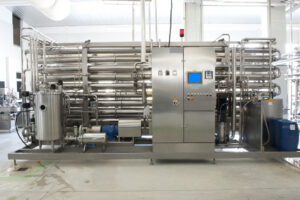
Rodem has supplied sanitary process equipment to food, beverage, dairy, and personal care manufacturers since 1971. As an Alfa Laval Premium Master Distributor, our team helps specify pumps, valves, and fluid handling equipment matched to each process. Our engineering and fabrication team also designs and builds custom skidded systems with documented materials and welds.
If you’re evaluating equipment for a new line or replacing aging components, talk to our team about the specs that will make the biggest difference for your process.
