
Skidded systems have become a go-to solution for food, beverage, and personal care manufacturers looking to add capacity, upgrade a process, or replace aging equipment without shutting down a line for months. But a skid is only as good as the engineering behind it. Rodem’s process engineers have spent decades designing, fabricating, and installing skid systems for sanitary processors, and they consistently point to the same handful of factors that separate a skid that performs from one that becomes a maintenance headache. Here’s what they want plant managers and process engineers to know before starting a skid project.
1. A skid is only as good as the process engineering behind it
A skidded system isn’t just equipment bolted to a frame, it’s a complete process built to meet a specific yield, throughput, and cleaning requirement. Rodem’s process engineering work starts with plant layout, process block diagrams, and P&ID development before any fabrication begins, because the equipment selection, piping runs, and instrumentation all depend on getting that upfront design right. Skipping this step, or treating it as an afterthought to equipment procurement, is one of the most common reasons a skid underperforms once it’s installed.
2. Integration with existing processes matters as much as the skid itself
A skid doesn’t operate in isolation. It has to tie into upstream and downstream processes, existing utilities, and the plant’s available footprint without disrupting production elsewhere on the floor. Rodem’s engineers evaluate how a new skid will interact with the systems already in place – from where it draws product and utilities to how it discharges – so the finished module fits the plant’s actual workflow instead of creating a bottleneck somewhere else in the line.
3. Off-site fabrication protects both quality and your production schedule
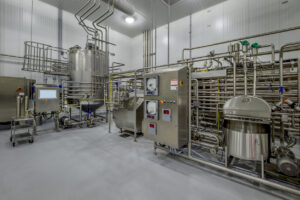
Building a skid in a controlled fabrication shop, rather than piecing it together on the plant floor, gives engineers more control over weld quality, sanitary design standards, and testing before the system ever reaches your facility. It also means far less disruption to ongoing production, since the bulk of the construction and testing happens off-site. For food, beverage, dairy, and personal care processors where downtime has a direct cost, that difference in approach can significantly shorten the time a line is out of commission for a tie-in.
4. Sanitary design standards aren’t optional, even inside a compact footprint
Skids are often chosen specifically because they solve a space problem, fitting critical process components into a tight area or an existing line. But a smaller footprint doesn’t mean sanitary design standards get relaxed. Rodem’s engineers hold skid systems for CIP, mixing and blending, filtration, separation, and SIP applications to the same sanitary fabrication requirements as any other build, including high-purity orbital welding for consistent, inspectable welds throughout the system.
5. The right skid depends on your specific process, not a standard template
Steam-in-place, mixing and blending, filtration and separation, ozone, aseptic, and hot fill skids all solve different problems, and the right choice depends on the process itself, not a one-size-fits-all package. Rodem’s engineers work through a facility’s actual constraints, whether that’s spatial limitations, an expedited timeline, expansion plans, or the need for manufacturing flexibility as ingredients and regulatory requirements change, before recommending a configuration. A skid built around a generic template rarely holds up as well as one engineered around the process it’s actually meant to run.
Talk to Rodem About Your Next Skidded System
Rodem has been engineering, fabricating, and installing skidded systems for food, beverage, dairy, and personal care processors since 1971. If you’re weighing whether a skid system makes sense for an upcoming project, get a consultation with a Rodem representative, or learn more about our Skid Systems and Process Engineering capabilities.
